

A few thoughts on sect and navigating change
This post is a continuation of thoughts I shared here on how night consciousness can help us navigate liminal periods. I extend that discussion by considering the ways that night (nocturnal) approaches to change and initiation can feed into and resource day (diurnal) approaches.

Photo by Fernando Strabuli on Unsplash
I’m fascinated by writer adrienne maree brown’s north star of “growing a garden of healing ideas.” I love thinking about the ways that sometimes seemingly disparate ideas connect to and synergize each other. I’m especially interested in the ideas and tools that help us to navigate change. One thing I’m curious about is how the Hellenistic doctrine of sect can help us to do that.
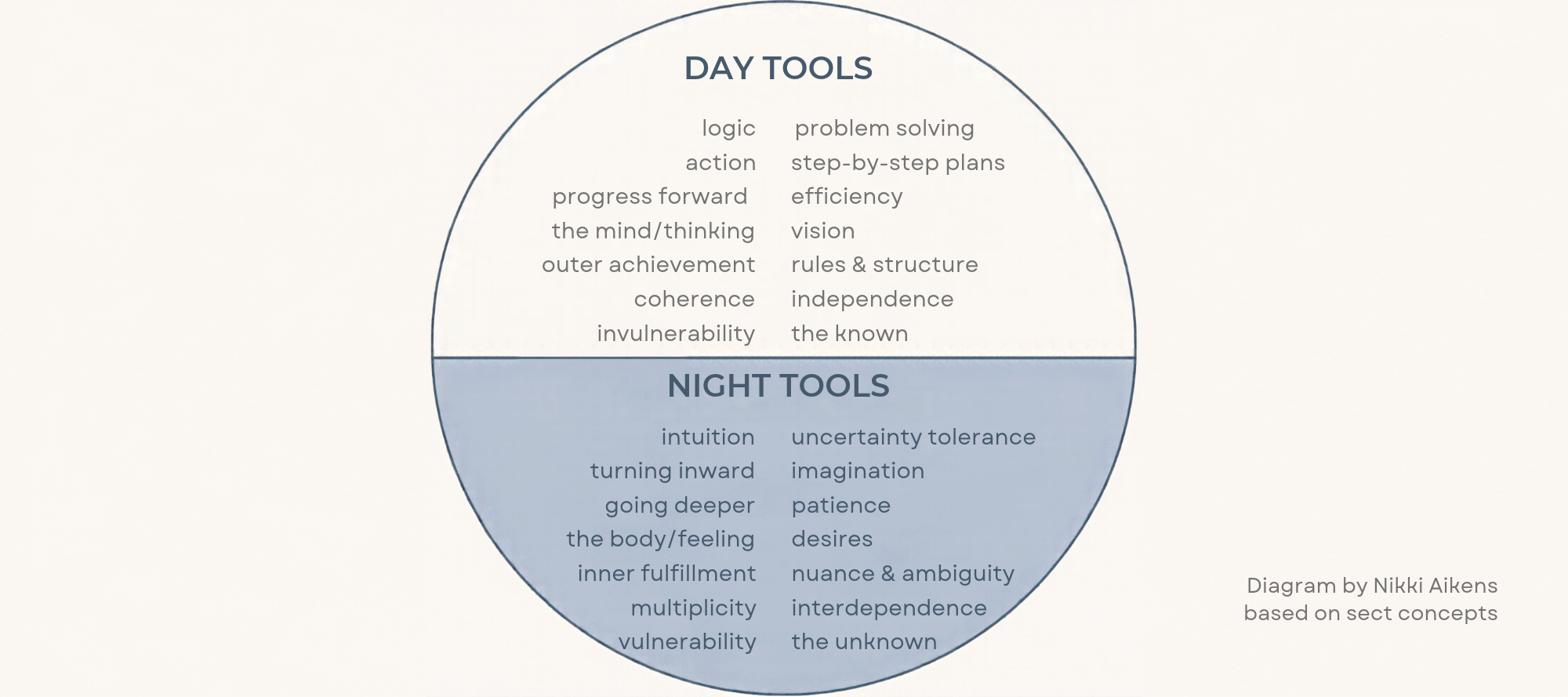
Sect highlights the distinction between day and night consciousness. It assumes that the quality of light at a given moment in time shapes how we orient ourselves to the terrain we are navigating. It shapes the tools we use, what motivates us, and our preferences and needs as we make our journey. Day consciousness is focused on our external, observable experiences in the world and what we individually achieve. Examples of day tools include problem solving, invulnerability, independence, coherence, the mind/thinking, progress forward, vision, history/the known, action, logic, efficiency, rules and structure, outer achievement, and step-by-step plans.
Night consciousness is focused on our internal or felt experiences and who we are in connection to others. Some night tools include uncertainty tolerance, vulnerability, interdependence, multiplicity, the body/feeling, going deeper, desires, new directions/the unknown, turning inward, intuition, patience, nuance and ambiguity, inner fulfillment, and imagination.
What does sect mean for navigating change? I think it deeply shapes the ways that we orient ourselves in times of uncertainty and transition.
The day’s approach to navigating change
The day is deeply concerned with our external world and experience—from what we’re doing about it to what we think and say about it. It values the visible and tangible world and making strides in it. In response to change, day will prioritize having a vision or goal that we can concretely move towards (preferably one that isn’t too far afield from what we already know or from what others expect of us) and figuring out how best to make progress towards it. Because day cares about what we can see, it takes a logical approach to dealing with change and will lean on planning and problem solving and what it knows works, helping we to move forward as efficiently, independently, and invulnerably as possible.
When we need support or guidance to move through change, day approaches incline us towards changing our behaviors or thinking. A few examples include leaning into affirmations, new narratives or mindsets, manifestation techniques, or more functional behaviors.
The night’s approach to navigating change
The night cares about our internal world and experience, including what we’re feeling, desiring, and learning. The night values what’s happening within us and what can be generated by staying open to the unknown, our body’s messages, and who and what offer nourishment. In response to change, the night wants us to slow down and turn towards more subjective ways of knowing so that we can create from new desire, possibility, and parts of ourselves. Night takes a non-linear approach to dealing with change and views times of transition as blank canvases, inviting us to open in new and unexpected directions (and not solely based on how past versions of ourselves or others would define us).
When we need support or guidance to move through change, night approaches point us toward what promotes our presence, inner fulfillment, and interconnectedness. Some examples include leaning into somatic practices, embodied routines and rituals, relationships, or art that feeds deep feeling and imagination.
Bridging night and day
Our natal charts point to the tools we naturally lean on. If we were born during the day (after sunrise), day consciousness is more natural for orienting to the world. If we were born at night (after sunset), a night consciousness is. But we live in a culture that heavily favors day consciousness and tools—we are all conditioned towards the day and may turn towards it regardless of our chart’s disposition. The dominant culture often sees change and the disruption of order and stability that accompanies it as something to be fixed or problem solved. When faced with change, we can feel an urgency to move from the in-between and to figure out how to be “successful” in that area(s) of life again as quickly as possible.
But we need night too. In nature, night and day concepts always accompany each other. There is ebb (night) and flow (day), inhale (night) and exhale (day), fallow periods (night) and times of bloom (day), for example. The contractions of night always make way for the expansions of day, and the expansions of day always result from the contractions of night. Night concepts frequently show up as sourcing day ones in all sorts of areas:1
Astrologer Jason Holley points out, for example, that “the night is the actual beginning of life; it sources day. In most mythologies, the creation story happens at night, with night as the opening space. [Night] is a fertile void and not an empty void.”
Somatic practitioner Staci K. Haines teaches that wanting, longing, and imagination are somatic experiences (night), and tuning into them helps us to feel into what we are called to do and build in our lives and world (day).
In her essay Uses of the Erotic, Black feminist thinker and writer Audre Lorde speaks of the power of connecting to our deepest desires and joys (night) and the ways that doing so expands what we see (day) as possible and necessary for ourselves and our lives. As she says, “Our visions (day) begin with our desires (night).”
To me, this means that night and day are not separate; they are linked. They are meant to be in conversation, to interact, to shape each other.
“But when we begin to live from within outward, in touch with the power of the erotic within ourselves, and allowing that power to inform and illuminate our actions upon the world around us, then we begin to be responsible to ourselves in the deepest sense. For as we begin to recognize our deepest feelings, we begin to give up, of necessity, being satisfied with suffering and self-negation, and with the numbness which so often seems like their only alternative in our society. Our acts against oppression become integral with self, motivated and empowered from within.”
I wonder what we miss out on when we neglect night tools when we are navigating change. What futures become less possible? Who might we become instead if we approach the moments of change in our lives by allowing what both the day and night offer? If we tuned into more subjective ways of knowing first, into the vulnerability and generativity of not knowing, into our part in a bigger whole—and let what we find help us go back into the world?
In a world that compels us to always turn towards the day, I believe that making space for night tools opens us to more possibilities for the change we seek. And because change is relational—we are never changing in isolation or a vacuum—that includes new possibilities not only for how change shapes us personally but also how it in turn affects all those our lives touch. We might all benefit from reflecting on our own relationship to day and night tools, how we tend to engage with change, and the ways we might do so more fruitfully.
1Emphasis and italics in the bullets in this section are my own.
Resources
Felix, Ariana. “How to Build Your Dreamworld 3.0: AKA Worldbuilding School Disorientation” webinar, n.d.
Haines, Staci K. “The Politics of Trauma: Somatics, Healing, and Social Justice.” North Atlantic Books, 2019.
Holley, Jason. “Psychologizing Sect: Night, Day, and Twilight Consciousness” webinar series. Available online at https://jasonholley.net/psychologizing-sect-bundle, 2019.
Lorde, Audre. "Uses of the Erotic: The Erotic as Power." Sister Outsider: Essays and Speeches, Crossing Press, 1984, pp. 53–59.