

How night consciousness can help us navigate change
Times of deep change and transition are incredibly tender and vulnerable. Leaving our past behind and moving towards a new version of our lives is uncomfortable, whether that change is hoped for or unexpected, a small leap or a big one, within ourselves or for the world to see. There can be shakiness, fear, exhaustion, hope that feels fragile.
These awkward, uneasy periods of our lives can feel like the darkness of night: we cannot depend on our usual ways of navigating them. In these moments, we often want to find ways to turn on the light. But more often what we need are tools for being with the dark.
“Whenever new life grows and emerges, darkness is crucial to the process. Whether it’s the caterpillar in the chrysalis, the seed in the ground, the child in the womb, or the True Self in the soul, there’s always a time of waiting in the dark.”
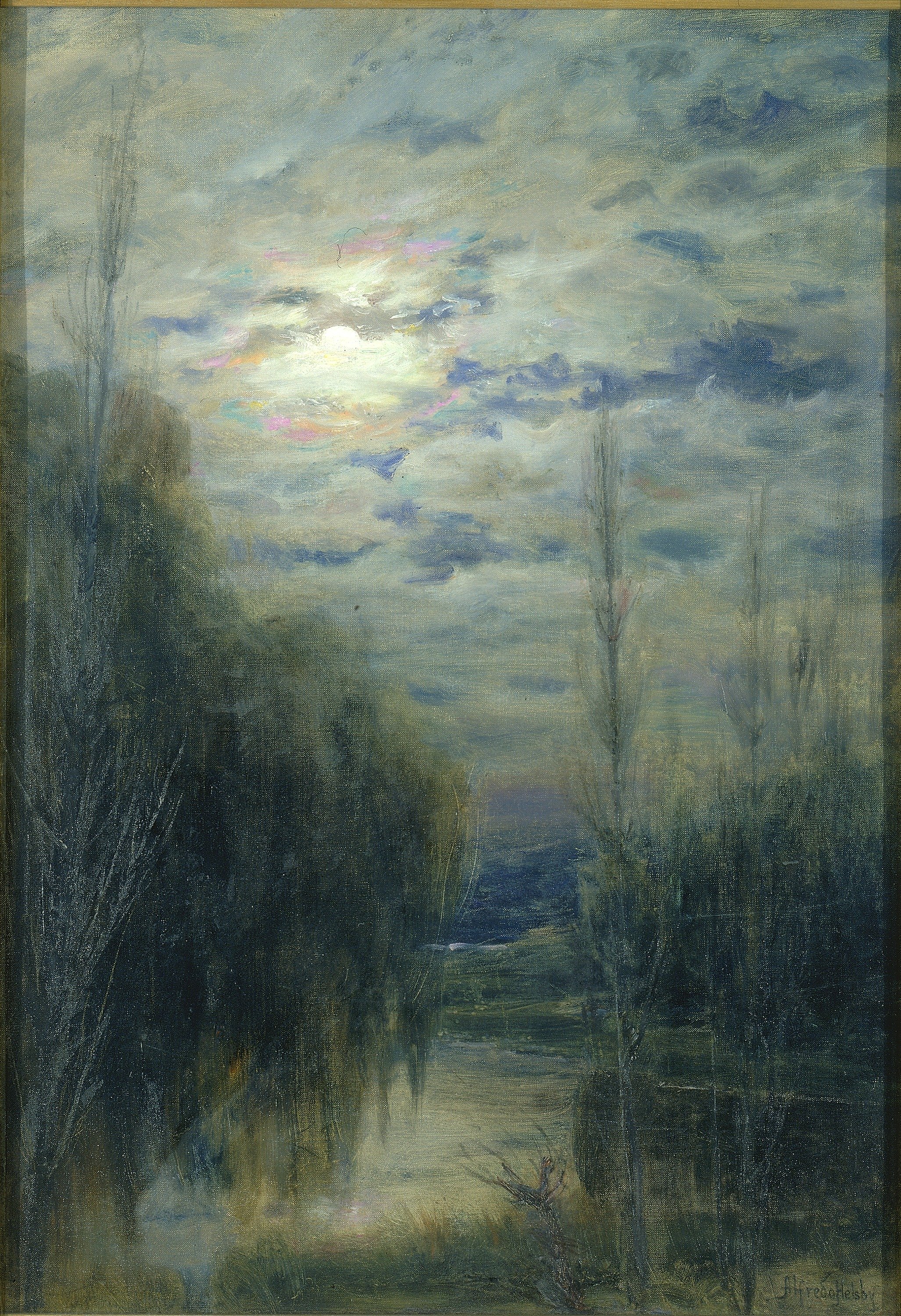
“Full Moon, Limache, Chile,” by Alfredo Helsby, public domain.
Many writings and teachings say that times of transition and uncertainty are sacred periods. That they are soulmaking ones, potent stretches offering the possibility for renewing our lives. They open us up to the world and our place within it, as we become more permeable, wild, real.
Across spiritual traditions, there are countless stories that involve a period of darkness or of being lost that ultimately leads to creation or rebirth. Jesus entered the desert (and the garden and the tomb), Muhammad retreated to the mountaintop, the Buddha sat under the Bodhi tree. Nature also offers similar symbols of renewal: the waning of the moon each month, the magic of the butterfly’s chrysalis, needed fallow periods for the earth.
In astrology, there are many concepts that remind us of the necessity of the dark—the balsamic moon phase, 12th house profections or transits, the doctrine of sect, for example. Sect is a concept that points us to a consciousness of day (diurnal) and of night (nocturnal). It is primarily used to tell us how charts and placements within them are inclined to engage with the world. The day sect prioritizes our actions in the world, our personal achievements, our ability to make visible, linear progress. The night sect, in contrast, focuses us on our internal worlds, on what brings us inner fulfillment, on moving our lives in intuitive, often non-linear directions.
I believe sect can help us show up for change. In seasons of becoming, we often need more of what the night can offer. We need to be present with our experience and ourselves, to turn towards what we feel. The day wants us to feel invulnerable, to focus on our strategy and a plan and getting “back on track”. To feel certain about what to do and where to go next. But night reminds us that life is inherently vulnerable. It asks us to be with our process, to sit with our questions, to let ourselves move in unexpected directions. It invites us to do more self-tending, to make space for what we need.
The night is generative and creative, a place where we can discover more possibility. There are things that only emerge in the cover of night. In the darkness, we are learning to be quiet and listen. We are learning to turn towards ways of knowing beyond our thinking minds. In the fertile potential of the unknown is where we learn to let go of how things should be and open to what could be.

“Celestial Sea of Stars.” Image courtesy NASA/JPL-Caltech/Univ. of Wisc.
The night asks us to be patient. It does not enforce deadlines or ask us to meet arbitrary timelines for healing or deciding or knowing. It requires us to slow down, to take the time that we need, to move one step at a time. We cannot move as quickly in the dark, after all. Night reminds us that progress is not just about growing up and out; sometimes progress means journeying deeper into ourselves.
Change and transition are a journey. A consciousness of the night reminds us that sometimes our souls need us to wander. To go “off track.” To “get lost.” To start over. To become something unfamiliar and brand new.
Liminal periods do not last for good. Neither does the night. It always makes way for twilight and for day. Perhaps in our moments of darkness, we can remind ourselves too that the night is not usually completely dark. There’s the gentle light of the moon and the stars. And there are parts of ourselves and our lives that we can only come to know in the quiet of the dark.
Resources
Below are some pieces that shaped my thinking when writing this post. I’m especially grateful for Jason Holley’s work, which rewired and expanded my understanding of night consciousness and sect.
Feiler, Bruce. “Life is in the Transitions: Mastering Change at Any Age.” Penguin Books, 2021.
Holley, Jason. “Psychologizing Sect: Night, Day, and Twilight Consciousness” webinar series. Available online at https://jasonholley.net/psychologizing-sect-bundle, 2019.
Kidd, Sue Monk. “When the Heart Waits: Spiritual Direction for Life’s Sacred Questions.” Harper Collins, 1990.
Mack, Lindsay. “Tarot for the Wild Soul: A Trauma-Informed Approach for Growth, Healing, and Grounding in the Present Moment.” Running Press Adult, 2026.
Margherita, Chloe. “The Sect Guidebook: A Comprehensive Collection on the Astrology of the Night and Day.” Available online at https://chloe-margherita.com/The-Sect-Guidebook, 2025.
Weller, Francis. “In the Absence of the Ordinary: Soul Work for Times of Uncertainty.” North Atlantic Books, 2025.